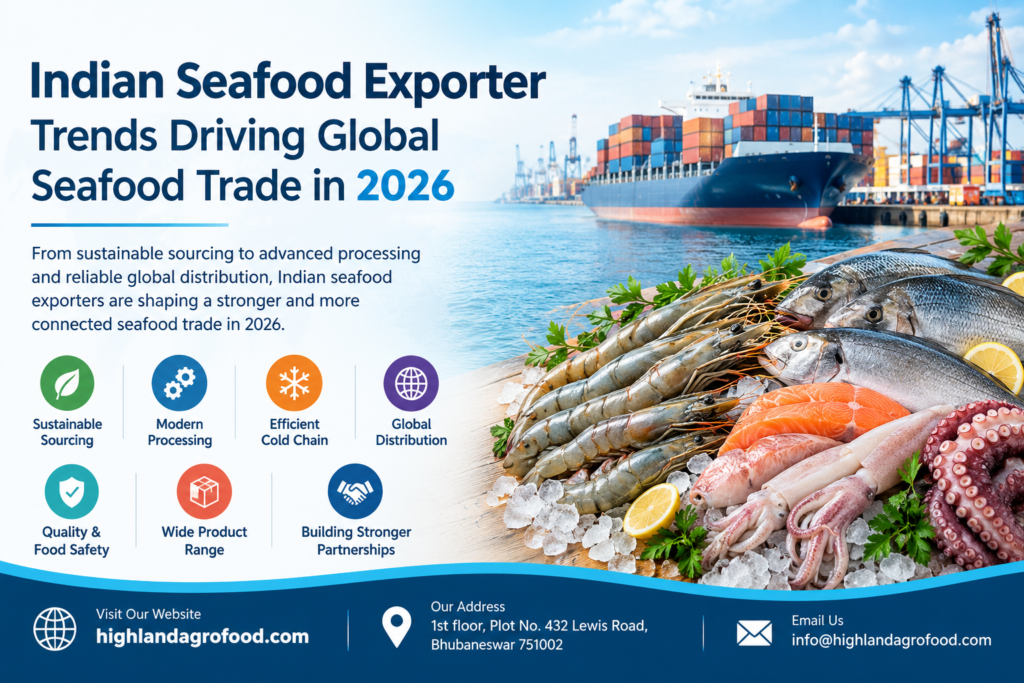
India has a strong position in the global seafood industry, supported by its long coastline, aquaculture farms, fishing communities, processing facilities, and established export network. Seafood demand continues to create opportunities for businesses that can provide consistent products while meeting food-safety, quality, and logistics requirements.
Modern seafood buyers are looking beyond basic product availability. They also consider traceability, processing standards, cold-chain management, responsible sourcing, packaging, documentation, and delivery reliability. These factors are especially important because seafood is perishable and needs careful handling from harvest to final delivery.
India’s seafood sector is also becoming more organised through improved farming practices, modern processing facilities, quality inspection systems, and temperature-controlled logistics. These developments help connect Indian seafood producers with buyers across international markets.
Some key areas shaping the seafood industry include:
- Responsible aquaculture and sourcing
- Better seafood processing systems
- Reliable cold-chain management
- Improved product traceability
- Food-safety and quality controls
- Product diversification
- International logistics
- Consistent supply for global buyers
These trends are relevant to importers, distributors, restaurants, retailers, food-service companies, and other businesses that depend on a reliable seafood supply.
Sustainable Sourcing Supports Long-Term Seafood Supply
Sourcing is one of the most important stages in the seafood supply chain. Responsible sourcing can help maintain product consistency while supporting farmers, fishing communities, and aquatic ecosystems.
Aquaculture plays a major role in seafood production. Farmed shrimp, for example, can provide a planned supply for international markets when farming operations follow appropriate health, biosecurity, and management practices.
A responsible sourcing strategy can involve:
- Working with trusted farmers and suppliers
- Maintaining traceability records
- Monitoring farming practices
- Supporting consistent production
- Following applicable food-safety requirements
- Inspecting products before processing
- Building long-term supplier relationships
Highland Agro Food states that it began in 2018 with a focus on sustainable shrimp farming in Odisha and has developed an integrated seafood operation involving more than 1,200 partner farmers across six Indian states. The company also states that it operates an aquafeed brand and an IQF-equipped processing facility.
An integrated supply model can help businesses coordinate different stages of production and processing. It may also support better planning between farmers, processors, exporters, and buyers.
Traceability is particularly useful in international seafood trade. Buyers often need information about the source and handling of products, especially when serving markets with strict food-safety and import requirements.
Sustainable sourcing is also connected to long-term business stability. Seafood companies depend on healthy aquatic environments and reliable farming communities. Responsible practices can therefore support both commercial activity and the resources required for future production.
For buyers, a supplier’s sourcing approach can provide useful insight into the overall reliability of its supply chain.
Modern Processing and Cold Chain Help Maintain Quality
Seafood requires careful handling because temperature changes, delays, and poor storage conditions can affect product quality and safety. Processing facilities therefore have an important role in preparing seafood for domestic and international markets.
After harvesting, seafood may pass through several stages:
- Receiving and quality inspection
- Cleaning and preparation
- Sorting and grading
- Processing
- Freezing
- Packaging
- Cold storage
- Transportation
- Export documentation
- International delivery
The processing operation described by Highland Agro Food has a stated production capacity of 80 metric tonnes per day, with seafood cleaned, sorted, graded, and prepared under hygiene and quality standards.
Freezing is also important for international seafood distribution. IQF, or Individual Quick Freezing, allows individual seafood pieces to be frozen separately. This can make products easier to portion, store, and use.
Cold storage provides another important part of the supply chain. Highland Agro Food states that it has more than 10,500 metric tonnes of in-house cold-storage capacity.
Maintaining a suitable cold chain means controlling temperature during storage, handling, transportation, and delivery.
A dependable cold-chain system can include:
- Appropriate refrigeration equipment
- Regular temperature monitoring
- Proper packaging
- Efficient loading and unloading
- Planned transportation
- Controlled storage conditions
- Coordination between processing and logistics teams
For international buyers, maintaining product conditions during long-distance transportation is particularly important.
The cold chain should therefore be viewed as a complete system rather than a single storage step. Processing, packaging, cold storage, shipping, and final delivery all need to work together.
Good temperature management can help reduce quality risks and support consistent seafood products for international customers.
Product Variety Helps Meet Different Market Needs
Seafood markets are diverse. Restaurants may need particular cuts or sizes, while wholesalers and retailers may have different packaging and product specifications. Food-service companies can also require products in formats that make preparation easier.
A supplier with multiple seafood categories can provide buyers with more options.
Common export categories include:
- Vannamei shrimp
- Black Tiger shrimp
- Wild-caught shrimp
- Whole fish
- Fish fillets
- Squid
- Cuttlefish
- Octopus
The Highland Agro Food website lists Vannamei Shrimp, Black Tiger Shrimp, Wild Caught Shrimps, Fish, and Cephalopods among its product categories. It also lists whole fish and fillet fish products.
Shrimp remains an important product category for many seafood markets. Different varieties and processing formats can serve different customer requirements.
Fish products also offer flexibility. Whole fish may suit some wholesale and food-service buyers, while fillets can be more convenient for restaurants, retailers, and consumers.
Cephalopods such as squid, cuttlefish, and octopus are also important parts of the seafood trade. These products can be supplied in different formats depending on processing capabilities and customer specifications.
Product variety can help seafood businesses respond to changing market demand. However, offering multiple products is useful only when quality and consistency can be maintained across the product range.
Buyers should therefore consider product specifications, processing capacity, storage facilities, quality controls, packaging, and export experience when evaluating suppliers.
A well-managed product portfolio can make it easier for international buyers to source several seafood categories through a single supply relationship.
Reliable Distribution Builds Strong Seafood Supply Chains
International seafood trade requires coordination between farms, processors, cold-storage facilities, logistics providers, shipping companies, importers, distributors, and final customers.
An exporter needs to manage these connections carefully because seafood can travel thousands of kilometres before reaching its destination.
The qualities buyers often look for include:
- Consistent product specifications
- Reliable supply planning
- Appropriate documentation
- Food-safety compliance
- Suitable packaging
- Temperature-controlled transportation
- Clear communication
- Timely shipment coordination
Highland Agro Food states that its operations extend across more than 30 countries and that its markets include the USA, Europe, the Middle East, China, South Korea, Japan, and India. The company also states that it has more than 2,000 employees.
The company’s website displays certifications including IFS, BAP, HACCP, FDA, Halal, and ISO. Buyers should verify current certification status and specific requirements directly with the supplier before placing orders.
International seafood markets can have different import regulations, labelling rules, documentation requirements, and food-safety standards. Exporters therefore need systems that can support the requirements of different destinations.
Reliable communication is equally important. Buyers need clear information about product specifications, availability, shipment schedules, packaging, and documentation.
As seafood demand changes, businesses also need to adapt to factors such as production cycles, consumer preferences, logistics costs, regulations, and market conditions.
A strong export operation connects sourcing, quality inspection, processing, cold storage, packing, and logistics into one coordinated supply chain.
Conclusion
The global seafood market continues to create opportunities for Indian producers and exporters. India’s aquaculture sector, fishing resources, processing capabilities, and growing international distribution network provide a strong foundation for serving buyers in different regions.
For an Indian Seafood Exporter, long-term success depends on more than product availability. Responsible sourcing, quality inspection, modern processing, cold-chain management, traceability, appropriate packaging, and reliable logistics all contribute to a dependable seafood supply chain.
Buyers can benefit from evaluating suppliers based on the complete operation rather than looking only at price. Production capacity, product range, storage facilities, certifications, sourcing practices, export markets, and communication should all be considered before establishing a long-term business relationship.
The seafood industry is also moving toward greater attention to responsible production and supply-chain transparency. Companies that maintain consistent standards while adapting to changing buyer requirements can be better positioned to serve international markets.
With careful sourcing, controlled processing, reliable cold storage, and organised distribution, India’s seafood sector can continue to play an important role in global food supply.
FAQs
1. What products can an Indian Seafood Exporter provide?
An Indian Seafood Exporter may supply shrimp, fish, squid, cuttlefish, octopus, and other seafood products. Available varieties and formats depend on the supplier’s sourcing and processing capabilities.
2. How can buyers request seafood product information?
Buyers can use the Contact Us section to request information about products, specifications, availability, packaging, and export requirements. Direct communication is recommended for current commercial details.
3. What seafood categories are available?
Seafood suppliers may offer Vannamei shrimp, Black Tiger shrimp, wild-caught shrimp, fish, and cephalopods. Product formats can vary according to market and buyer requirements.
4. Why is cold-chain management important?
Cold-chain management helps maintain suitable temperature conditions from processing through transportation and delivery. Proper temperature control is important for maintaining seafood quality and safety.
5. Where can buyers find general company information?
The website’s Faq and Contact Us sections can provide useful general information. Buyers can also contact the company directly for product-specific enquiries.
6. Does an Indian Seafood Exporter serve international markets?
Yes, Indian seafood exporters can serve international markets when products meet the relevant destination requirements. Exporters may supply different regions based on product availability, regulations, documentation, and buyer specifications.