
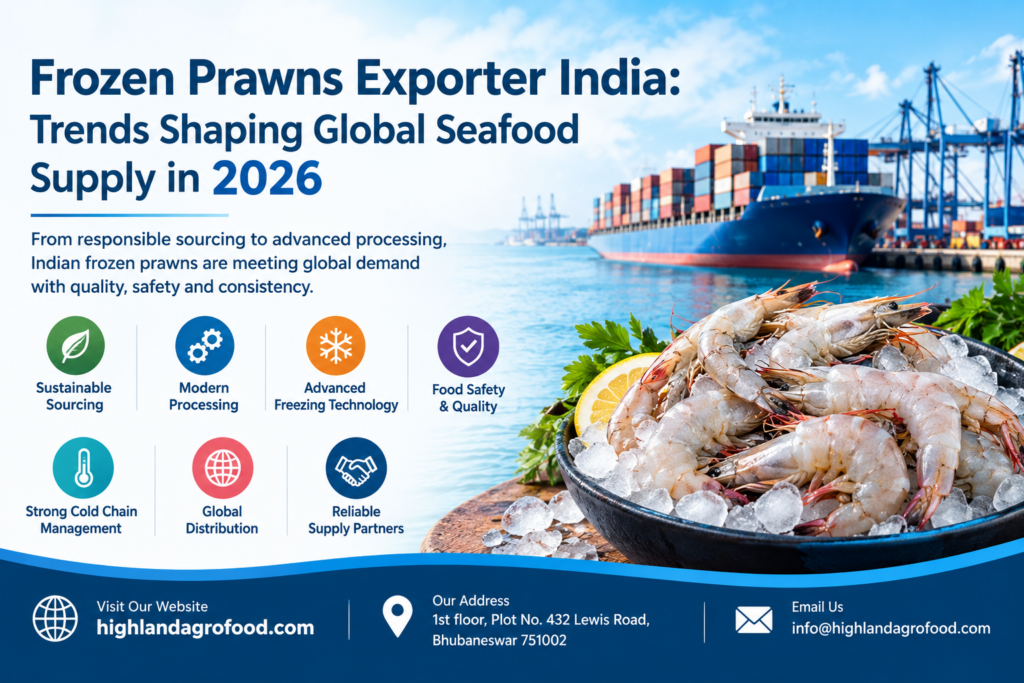
India has an established position in the global seafood industry, supported by aquaculture, marine resources, processing facilities, cold-chain infrastructure, and export networks. Among the many seafood products supplied to international markets, frozen prawns remain an important category for restaurants, food-service companies, retailers, wholesalers, and seafood distributors.
The frozen prawn trade involves much more than harvesting and freezing seafood. Product quality depends on several connected stages, including responsible sourcing, farm management, harvesting, processing, grading, freezing, packaging, storage, transportation, and export documentation.
Global buyers are also paying greater attention to food safety, traceability, consistent product specifications, and responsible sourcing. These factors are influencing how seafood exporters manage their operations and communicate with customers.
India’s aquaculture sector provides an important foundation for shrimp production. Farmed Vannamei shrimp and Black Tiger shrimp are among the products associated with the country’s international seafood trade. Modern processing facilities and cold-storage systems further support the movement of frozen seafood to overseas markets.
Several trends are influencing the frozen prawn sector in 2026:
- Greater focus on responsible aquaculture
- Improved traceability systems
- Modern processing and freezing technology
- Better cold-chain management
- Stronger food-safety controls
- Consistent product grading
- Increased product diversification
- More organised international logistics
- Growing demand for dependable seafood suppliers
These changes are useful for both exporters and buyers because a reliable supply chain can help maintain product quality and reduce avoidable risks.
Responsible Aquaculture Supports Consistent Prawn Supply
The quality of frozen prawns begins at the source. Farming conditions, water quality, feed management, disease prevention, harvesting practices, and handling can all influence the final product.
Aquaculture allows seafood producers to plan production and supply more consistently. However, responsible farming practices are important for maintaining long-term productivity and protecting the surrounding environment.
Responsible aquaculture can involve:
- Selecting suitable farming locations
- Maintaining appropriate water conditions
- Following biosecurity measures
- Monitoring animal health
- Using feed responsibly
- Maintaining farm records
- Following approved farming practices
- Maintaining traceability from farm to processor
Highland Agro Food states that it works with more than 1,200 partner farmers across six Indian states and has developed an integrated seafood operation covering areas such as aquaculture, aquafeed, processing, cold storage, and distribution.
An organised farming network can help seafood businesses coordinate production and harvesting schedules. It can also provide better visibility into the source of products moving through the supply chain.
Traceability is becoming increasingly important in international seafood trade. Buyers may need information about the origin, processing, handling, and movement of seafood products.
A clear traceability system can help businesses maintain records at different stages. It can also make it easier to investigate quality concerns if they occur.
Sustainability is another part of responsible sourcing. Seafood production depends on healthy aquatic environments and the people working within the farming and fishing sectors. Responsible practices can therefore support both business continuity and the long-term availability of seafood.
For international buyers, understanding a supplier’s sourcing approach can provide useful information when evaluating a potential long-term business relationship.
Modern Processing Helps Maintain Seafood Quality
Prawns are perishable products and need careful handling after harvesting. Processing facilities must follow suitable hygiene, temperature, sorting, grading, and packaging procedures to prepare seafood for international markets.
A typical frozen prawn processing chain can include:
- Receiving harvested prawns
- Initial quality inspection
- Cleaning
- Sorting
- Grading by size
- Processing according to specifications
- Freezing
- Glazing when required
- Packaging
- Cold storage
- Shipment preparation
The exact processing method depends on the product format and buyer requirements.
Individual Quick Freezing, commonly called IQF, is one technology used in frozen seafood processing. It allows individual pieces to be frozen separately, which can make storage, handling, and portioning more convenient.
Grading is also important for commercial buyers. Restaurants, retailers, wholesalers, and food manufacturers may require particular sizes and specifications for their operations.
Consistent grading can help buyers maintain predictable inventory and product quality.
Packaging has a practical role as well. It protects the product during storage and transportation while providing information required for handling and identification.
Buyers may review details such as:
- Product variety
- Size and grade
- Processing format
- Net weight
- Packaging type
- Storage requirements
- Batch information
- Country of origin
- Applicable certifications
Highland Agro Food states that its processing facility has a production capacity of 80 metric tonnes per day. The company describes its processing operation as involving cleaning, sorting, grading, and preparation under hygiene and quality standards.
Modern processing systems can help seafood businesses handle larger volumes while maintaining established specifications. However, processing capacity needs to be supported by appropriate quality-control procedures.
Food safety should remain a central part of the operation. Suitable hygiene practices, controlled processing areas, employee procedures, equipment maintenance, and product monitoring can all contribute to safer seafood handling.
Cold Chain and Logistics Connect India With Global Markets
Freezing seafood is only one part of preserving product quality. The frozen product also needs suitable storage and transportation conditions until it reaches the buyer.
Cold-chain management covers the movement of seafood through different stages, including processing, storage, transportation, shipping, and final delivery.
A reliable cold-chain system can involve:
- Temperature-controlled processing
- Suitable cold-storage facilities
- Regular temperature monitoring
- Proper packaging
- Refrigerated transportation
- Planned loading procedures
- Efficient port coordination
- Timely shipment management
Highland Agro Food states that it has more than 10,500 metric tonnes of in-house cold-storage capacity.
Large cold-storage capacity can help manage processed seafood before export shipments are dispatched. It may also provide greater flexibility when coordinating production schedules with international shipping arrangements.
International logistics require careful planning because frozen seafood can travel long distances before reaching its destination. Delays, unsuitable storage conditions, or poor handling can create quality risks.
Exporters therefore need to coordinate several activities at the same time. These can include product preparation, documentation, packaging, cold storage, transportation, customs procedures, and shipping schedules.
Different countries may also have their own requirements for imported seafood. Regulations can cover food safety, labelling, documentation, permitted products, inspections, and certification.
Buyers should always verify current requirements for their specific destination market before confirming an international seafood order.
Clear communication between exporters and buyers is also important. Product specifications, quantities, packaging, shipment schedules, documentation, and delivery requirements should be agreed upon in advance.
A reliable logistics system helps make seafood procurement more predictable for international customers.
Product Variety and Quality Standards Strengthen Export Markets
Global seafood buyers have different requirements depending on their businesses. A restaurant may need specific prawn sizes, while a supermarket could require retail-ready packaging. Food manufacturers may need particular processing formats for their products.
Product variety can therefore help exporters serve different market segments.
Frozen seafood categories can include:
- Vannamei shrimp
- Black Tiger shrimp
- Wild-caught shrimp
- Whole fish
- Fish fillets
- Squid
- Cuttlefish
- Octopus
The Highland Agro Food website lists Vannamei shrimp, Black Tiger shrimp, wild-caught shrimp, fish, and cephalopods among its seafood product categories.
Offering different products can help buyers source multiple seafood requirements through a single supplier. However, product variety needs to be supported by consistent processing and quality management.
International buyers commonly consider several factors when evaluating a seafood supplier:
- Product specifications
- Processing capacity
- Cold-storage facilities
- Quality-control systems
- Traceability
- Food-safety practices
- Certifications
- Packaging options
- Export experience
- Communication and logistics
Certifications can provide additional information about a company’s food-safety and production systems. The certifications and approvals relevant to a shipment depend on the product and destination market, so buyers should confirm current certification status directly with the supplier.
The global seafood market is also influenced by consumer preferences, aquaculture production, weather conditions, transportation costs, regulations, seasonal supply, and international trade policies.
Exporters need to adapt to these factors while maintaining consistent product specifications.
For businesses purchasing frozen prawns regularly, consistency can be especially important. Changes in size, quality, packaging, or availability can affect menus, retail planning, inventory management, and production schedules.
This makes supplier relationships an important part of seafood procurement.
Conclusion
The frozen prawn sector continues to play an important role in India’s seafood export industry. Strong aquaculture production, modern processing facilities, cold-storage infrastructure, and international logistics provide the foundation for serving buyers across different markets.
For a Frozen Prawns Exporter India, maintaining long-term success requires attention to the complete supply chain rather than focusing only on the final product. Responsible sourcing, farm-level traceability, careful processing, accurate grading, controlled freezing, suitable packaging, cold-chain management, and reliable transportation all contribute to product quality.
International buyers can benefit from evaluating suppliers based on their complete operational capabilities. Processing capacity, storage infrastructure, food-safety systems, certifications, product range, export experience, and communication should all be considered before establishing a long-term relationship.
The seafood sector is also moving toward greater supply-chain transparency and responsible production. Companies that combine reliable sourcing with modern processing and organised logistics can better respond to the expectations of international customers.
As demand for convenient frozen seafood continues, India can remain an important supplier to global markets. The combination of aquaculture, processing expertise, cold-chain infrastructure, and export experience can support continued growth while maintaining attention to quality and food safety.
FAQs
1. What does a frozen prawn exporter offer?
A frozen prawn exporter generally manages sourcing, processing, freezing, packaging, storage, and international shipment coordination. Product sizes and formats depend on buyer requirements.
2. How can buyers make an enquiry?
Buyers can visit the company’s Contact Us section to request information about products, specifications, availability, packaging, and export requirements.
3. Why is cold storage important for frozen prawns?
Cold storage helps maintain appropriate temperature conditions after processing and before shipment. Proper temperature management supports product quality throughout the supply chain.
4. What should buyers check before ordering?
Buyers should review product specifications, size, grade, processing format, packaging, certifications, storage conditions, documentation, and destination-market requirements.
5. Where can general information be found?
The company’s Faq section can provide general information about products and operations. Buyers can contact the supplier directly for specific commercial enquiries.
6. Are frozen prawns suitable for international markets?
Frozen prawns are commonly traded internationally because controlled freezing and cold-chain transportation allow them to be stored and transported over long distances under suitable conditions.